Categories
News Successes

Summary of Stage I of the “Accessible Book” Project

Literature is often described as a window to the world. For many Deaf people, however, this window remained closed for years—not due to a lack of interest in culture, but because of language barriers. The “Accessible Book” project was created to gradually remove these barriers and open access to literature in a form aligned with the natural mode of communication of Deaf people.

In January 2026, the first stage of the project was completed. Its goal was to create accessible, multimedia adaptations of books and to establish organizational and substantive foundations for the further development of the initiative.

Accessibility Based on Polish Sign Language (PJM)

For people whose natural language and primary means of communication from birth is Polish Sign Language (PJM), traditional forms of access to literature—based solely on written text—do not provide full accessibility. PJM is a distinct visual-spatial language with its own grammar and structure. As a result, written Polish is a second language for Deaf users, and in some cases may even function as a foreign language acquired through education.

Within the “Accessible Book” project, it was assumed that translation into Polish Sign Language would be the primary channel of communication. Other layers—textual and audio—serve a complementary role, broadening the audience and enabling the project to be used by hard-of-hearing and hearing individuals, as well as educational institutions. This approach resulted in the creation of a multimedia publication format known as a sign-language book (migoksiążka), combining PJM translation, synchronized text, a supportive audio layer, and visual design.

A Library Accessible to Diverse Audiences

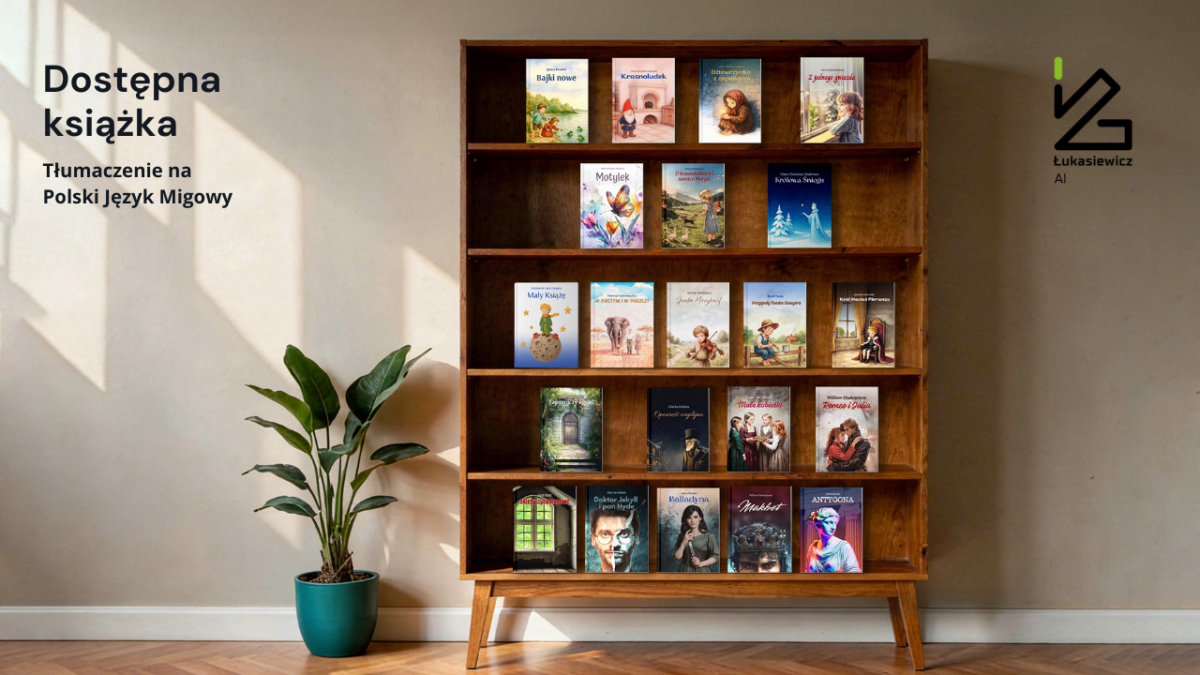
As part of the first stage of the project, 22 literary works were developed and made available. The digital library includes classic fairy tales and children’s stories, school reading materials, and works of fiction intended for young people and adults.
The available titles include works by authors such as Hans Christian Andersen, Antoine de Saint-Exupéry, Juliusz Słowacki, Henryk Sienkiewicz, Bruno Schulz, William Shakespeare, and Janusz Korczak. The selection aimed to ensure thematic, linguistic, and emotional diversity so that people of different ages and needs could benefit from the project’s resources.

The materials were published in a dedicated online library available at https://dostepnaksiazka.pl, which serves as the central platform for the project, as well as on a publicly accessible YouTube channel (https://www.youtube.com/@LukasiewiczAI), enabling broad and free access to the content.

Implementation and Scale of Work

Production took place in a specially prepared recording studio at Łukasiewicz – AI. The project involved nine professional Polish Sign Language interpreters—both Deaf and hearing—who have experience working with literature and education. Each interpreter brought a unique style and mode of interpretation, a diversity that is essential both for better reception by PJM users and for creating valuable, varied material for machine learning.
In total, 95 hours of video recordings were produced, not including the time required for post-production, layer synchronization, and preparation of the publications for release. The scale of this work demonstrates how time- and resource-intensive the manual creation of high-quality accessible literary content is. At the same time, the collected materials form the beginning of a structured resource that may be used in future research and development activities.

The first stage of the project was primarily production-oriented and pilot-based. The resulting recordings and textual materials initiated the process of building a dataset for machine learning. Even at this stage, the potential for future automation of selected elements of the process is evident—automation that could significantly improve workflow ergonomics, reduce production time, and optimize the use of resources.
For now, however, human expertise and the quality of manually prepared translations played a key role. As part of the pilot phase, a test recording using a digital avatar based on motion capture technology was also produced. This solution had an exploratory and conceptual character.

Summary

The completion of the first edition of the project leaves Łukasiewicz – AI with invaluable experience. The first stage of the “Accessible Book” project succeeded in opening what had remained closed for years—access to literature in the natural language of Deaf people. An accessible digital library, production infrastructure, and foundations for further research and development activities have been established.

The project was met with enthusiastic reception from the Deaf community as well as from the media, which highlighted its innovative character. The conclusion of the first stage also marks a starting point for future steps, should appropriate organizational and financial opportunities arise. “Accessible Book” remains an open project—open to development, new technologies, and above all, to people for whom literature should truly be accessible.

Formal Information

The project “Accessible Book – adaptation of books with Polish Sign Language (PJM) translation for society and machine learning” was carried out as the first stage between July 1 and December 30, 2025, and concluded in January 2026.
The task was commissioned by the President of the Łukasiewicz Research Network and financed through subsidy funds. The project was implemented in cooperation with the Integracja Foundation, an organization with over 30 years of experience in activities supporting people with disabilities.

Categories
News Successes

Łukasiewicz – AI in 2025

The year 2025 was a period of intensive research, institutional partnerships, and impactful projects for Łukasiewicz – AI, with both technological and societal significance. The Institute operates in the fields of artificial intelligence, cybersecurity, digital technologies, solutions addressing social exclusion, and Industry 4.0 — combining scientific knowledge with the needs of society and the public sector.

At the beginning of 2025, the EMC Laboratory (Electromagnetic Compatibility Testing Laboratory) celebrated its 20th anniversary. For two decades, it has supported the national industry in electromagnetic compatibility testing and safety assessments of electronic devices.

A symbolic milestone in branding and organization was the renaming of the Institute to Łukasiewicz Research Network – Institute of Artificial Intelligence and Cybersecurity (Łukasiewicz – AI). The new identity highlighted the Institute’s competencies in AI, data analytics, cybersecurity, decision support systems, industrial technologies, and technologies that improve quality of life.

In 2025, we initiated cooperation with the Katowice Special Economic Zone S.A. to support regional enterprises in adopting AI and modern technologies. The first joint initiative included pilot workshops for members of the Innovator Club focused on machine learning and cybersecurity, laying the groundwork for future educational and implementation projects.

In the field of digital infrastructure, we launched EdgePL — a national network of edge computing nodes developed together with partners from Poznan University of Technology, the National Information Processing Institute, and the Institute of Bioorganic Chemistry PAS. Funded by the Ministry of Science and Higher Education, the project aims to accelerate data processing, expand modern digital services, and strengthen independent technological infrastructure in Poland.

Throughout 2025, Łukasiewicz – AI participated in numerous national and international projects. Notably, OSCRAT (Open-Source Cyber Resilience Act Tools) supports organizations in complying with the EU Cyber Resilience Act. This solution was presented at international conferences, promoting Polish expertise in cybersecurity and technology compliance.

In the area of social and digital accessibility solutions, we organized multiple meetings, presentations, and workshops showcasing technologies that support people with diverse needs. A key initiative is Accessible Book — designed for Deaf people and users of Polish Sign Language (PJM). Books are translated into PJM by professional interpreters and made publicly available on the Institute’s YouTube channel. In parallel, a database of recordings is being developed as a dataset for machine learning — although still at an early stage, it provides a foundation for future work on models that better understand sign language.

In 2025, we showcased technological and expert solutions at numerous events — from the Silesian Science Festival to the Horizons of Science at the Silesian Planetarium, as well as film festivals and open-air cinemas, highlighting technologies that enhance cultural and educational accessibility.

Another recognition emphasizing the practical impact of our work was the award for the AudioMovie project in the “We Did It in Poland” competition, confirming that Łukasiewicz – AI innovations are recognized in communities promoting high-impact Polish technological solutions.

Beyond these initiatives, many other research projects and activities were carried out — our experts participated in industry conferences, panel discussions, and expert meetings, contributing to the development of knowledge and competencies in key areas of AI and cybersecurity.

These examples represent just a selection of events from the rich calendar of Łukasiewicz – AI in 2025, reflecting an active institute that combines scientific research with tangible benefits for the community, economy, and technological advancement.

This will close in 0 seconds